SEO as a field is very vast, knowing all the terms related to it is a hefty task. If you are interested in digital marketing and SEO, it is essential for you to be familiar with these concepts. While there are numerous terms in SEO, we will focus on the important ones that will help you effectively rank your website.
Familiarity with the concepts will make it easy for you to apply and relate to your website or webpage. Below, we have explained SEO terms and their meanings in detail for beginners.
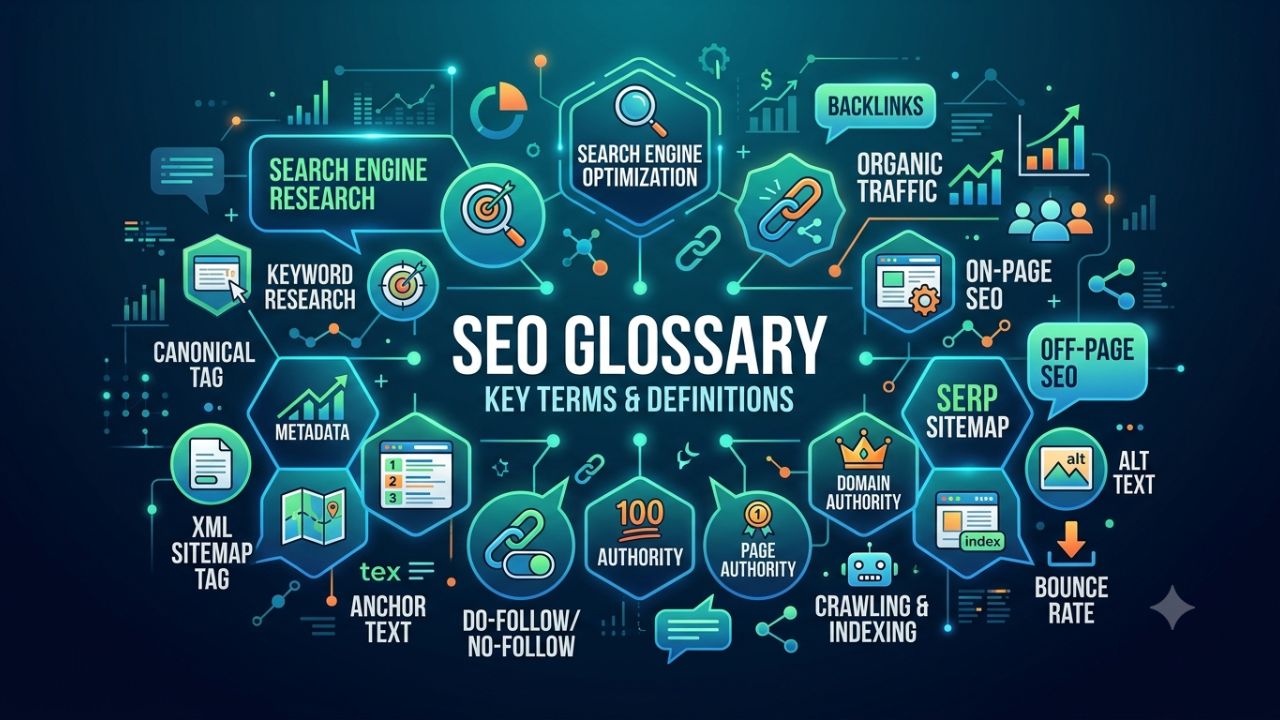
SEO Glossary
This dictionary explains, in a clear way, everything you need to know about SEO. Below mentioned in this SEO Glossary that you should when doing SEO.
301 Redirect: This serves as a signal to search engines, indicating that a visitor is being sent from one web page to another. In this way, you can inform the search engine that your original page has been redirected to a different URL.
404 Error: A type of technical SEO error that signals to a web page that there is no data on your site (often because it has been moved or deleted).
Algorithm: A search engine uses a complex computer program that enables you to instantly obtain results for anything. Search engines employ a combination of algorithms to deliver ranked web pages based on various ranking factors and numerous signals.
Alt Text: This is used for images. It helps search engines understand what the image is about. In this way, all your images also start ranking.
Anchor Text: Anchor text is a crucial component of SEO because, when used correctly, it can boost your rankings on search engine results pages (SERPs). It allows you to link specific pages using keywords, thereby helping visitors navigate between different pages on your site.
AMP: With the help of Accelerated Mobile Pages (AMP), you can make your site load very quickly on mobile devices. AMP is frequently used by news websites. It reduces your site’s loading time by compressing HTML, CSS, and JavaScript, as well as minimizing the number of website requests.
Answer Engine Optimization (AEO): AEO is a strategy that focuses on improving brand visibility in AI-powered answer engines. It prioritizes clarity, structure, and intent fulfillment over traditional ranking tactics.
Backlink: This is a link that creates a path from another website to your website. When a link on one web page connects to another web page, it is called a backlink.
Black Hat SEO: The technique used to quickly rank a site in search engines is known as Black Hat SEO. However, if you want to maintain your site’s ranking in the long run, this method is not safe and carries the risk of incurring a penalty.
Breadcrumb: This is a navigation element that shows your current location within the website’s structure. It is essential for blogging sites and is a very important factor for SEO ranking.
Bounce Rate: The bounce rate represents the percentage of visitors to a webpage or website who leave after viewing only a single page. It is a crucial factor for a site’s ranking; the lower the percentage, the better it is for your site. Generally, a “good bounce rate” varies from one website to another and also depends on the traffic source.
Broken Link: When you delete a page from your blog but its link remains accessible elsewhere, it is referred to as a “broken link”—meaning a link that leads to an error or points to a non-existent page. This can prove detrimental to your site.
Canonical tag: The canonical tag is the snippet of code added to a page to tell Google which URL we want it to index.
Click-Through Rate: CTR refers to the proportion of people who click on your link after seeing it in Google search results. Higher click-through rates mean more clicks or visits. The higher your website ranks on Google, the higher its Click-Through Rate (CTR) will be.
Crawling: We search on Google whenever we need specific content. But how do search engines like Google, Bing, and DuckDuckGo read this content? They use “Google Bots” for this purpose. This allows the search engine to identify the type of content present on a website. This entire process is known as crawling.
Content: Content is crucial for any website. It can be in the form of text, images, or videos. High-quality content plays a significant role in SEO and will positively influence your search engine ranking.
Core Web Vitals: CWV indicates your website’s loading time and also reflects the user experience. It is a Google Webmaster tool that includes the following three metrics:
- Largest contentful paint (LCP)
- First input delay (FID)
- Cumulative layout shift (CLS)
Domain: This is a website address—typically ending with an extension like .com, .org, or .net. For example, www.minidea.co.in is our website’s domain. A good domain name has a significant impact on your site’s SEO.
Domain Authority: Domain Authority (DA) is an SEO metric created by Moz. It emerged after Google stopped updating PageRank data. Search engines use Domain Authority to compare your website with others and rank the site based on that comparison.
Duplicate Content: When a webpage contains content that matches another website on the internet word-for-word, it is considered duplicate content. When Google encounters pages with duplicate content, it does not allow them to rank in search engines.
External Link: When you add a hyperlink to your content that points to a different domain, it is called an external link. These are crucial for ranking any webpage. For instance, whenever you reference a Wikipedia article on your website, you are creating an external link. You can add as many external links as you wish to your site’s pages.
Google Search Console: Google Search Console (GSC) is a free tool from Google that allows you to monitor the traffic coming to your website from Google. It helps identify issues on your site that could negatively impact your search engine ranking and enables you to check how Google crawls your site. Additionally, it provides valuable data—such as site impressions, the number of clicks, and search positions—which is crucial for ranking any website.
Google Analytics: This is analytics software developed by Google, designed to help you track various types of information regarding your website. It provides insights into traffic volume, traffic sources, visitor behavior, bounce rates, and much more. Additionally, by comparing past data with current data, it allows you to assess your website’s growth, strengths, and weaknesses.
Google PageSpeed Insights: There is an online tool for checking a website’s loading time that analyzes how quickly the site loads. Website loading time is crucial for any site’s ranking.
Guest Post: Whenever you publish your content on someone else’s blogging site, it is called a guest post. This is the best way to build links. It helps you create high-quality backlinks for your own site.
Heading: Headings are essential for creating good content. They help both visitors and search engine robots effectively understand the content of a webpage. There are five types of headings (H1 through H5), with the H1 tag being the most important; it indicates the main topic of the webpage.
Hidden Text: Whenever content on your site is hidden—meaning it is not visible to the visitor but is included in the webpage via code—it is considered a Black Hat SEO technique. Engaging in this practice can cause your site’s ranking to drop.
Indexed Page: A webpage discovered by the Google crawler has been added to the search engine index and is eligible to appear in search results for relevant queries.
Internal Links: Linking one page to another on the same domain is called internal linking. It connects one page of your website to another.
Keyword Research: The process of searching for specific words on the internet to optimize an article for SEO is known as keyword research. It involves identifying the words or phrases people use to find content online. It can also refer to the specific process of understanding how a particular word or group of words is searched for on the internet. This is crucial for ranking any article.
Keyword Density: Keyword density is the ratio between the number of times a specific keyword is used and the total word count of the content. For example, if you write a 500-word blog post on a topic and use the keyword five times, the keyword density will be 1%.
Keyword Stuffing: Bloggers often insert irrelevant keywords or repeatedly use specific keywords in their articles to boost their search engine rankings; this practice is known as “keyword stuffing.” It is a Black Hat SEO technique that violates Google’s Webmaster Guidelines.
LSI Keywords: Such keywords are related to your primary and focus keywords. Search engines use LSI keywords to determine which terms are most important for a given topic. Incorporating these keywords into your blog or webpage helps improve your ranking on major search engines like Google.
Links Building: The process of acquiring links to your website from high-quality websites relevant to your niche is known as link building. There are many ways to achieve this.
Local SEO: Local SEO techniques are used to help your website or business rank higher in search engine results for local people searching for your products or services.
Long Tail Keyword: Keywords consisting of more than three or four words are known as “Long-Tail Keywords.” For instance, “website is seo in digital marketing” (6 words) is a long-tail keyword, whereas “What is SEO” is a short-tail keyword. Generally, such keywords are less popular and consequently have a lower monthly search volume, making them much easier to rank for.
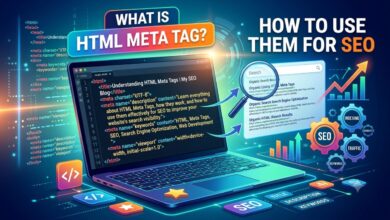
Meta Description: This is a brief summary of your webpage that often appears below your website link in search results. It informs readers about the webpage to entice them to click. Meta Description are crucial for Search Engine Optimization; ranking in SERPs without a meta description is very difficult.
Mobile-first indexing: Mobile-first indexing is Google’s new algorithm that evaluates whether your site is suitable for mobile users. If your site is not optimized for mobile, it will have a significant negative impact on the site’s ranking.
Niche: A topic centered around a specific subject or a single category is known as a “niche.” Micro-niche blogging is very popular these days. For instance, if you create content specifically about health or education, each of these constitutes a niche. You can start a blog on any such topic.
Negative SEO: SEO experts often resort to black-hat SEO methods to get their keywords ranked quickly. While this may help your keywords rank initially, they often drop out of search engine rankings very quickly. If you want to maintain your rankings in the long run, avoid using these techniques.
Nofollow Links: This is a type of link that has not been embedded with the rel="nofollow" attribute. The “nofollow” attribute instructs search engine crawlers not to follow the link on the webpage. Nofollow links simply do not allow search engine bots to follow the link; only visitors can follow them.
On-Page SEO: This is a content marketing strategy that helps increase a website’s authority and traffic through search engine optimization. It relies on various factors, such as page titles, meta descriptions, keywords, and image alt text. Its primary objective is to improve the likelihood of your site achieving a high ranking on search engines.
Organic Traffic: When a visitor arrives at your site after searching for specific keywords or queries on Google or Bing, it is referred to as organic traffic. Increasing organic traffic is quite challenging; it requires following numerous SEO tips.
Orphan Page: When a post is not linked from any page, it is referred to as an “orphan page.” It can take time for such pages to be crawled.
Page Authority: Page Authority was developed by Moz and indicates how a page is likely to rank on Search Engine Results Pages (SERPs); it has a score range of 1 to 100, with a higher score boosting your ranking.
PBN: A Private Blog Network (PBN) consists of a group of blogs owned by a single individual or a group. It comprises at least two websites where specific pages link to one another. Many people use PBNs to rank websites very quickly because they have an entire network of blogs at their disposal; furthermore, they can easily boost the Domain Authority (DA) and Page Authority (PA) of any new website through backlinks.
Referral Traffic: When traffic to your site comes from other websites instead of search engines, it is called referral traffic because it arrives via a referral from another site.
Rich Results: It is used to define structured data markup. Data included in a post via structured data markup is displayed effectively by search engines. Rich results typically appear as images, videos, text snippets, and other visual elements. It can also be used to create a more immersive experience for searchers interested in your brand or products.
Sitemap: This is an XML representation of your site that helps in easily locating all its pages. A sitemap facilitates the easy crawling of your website.
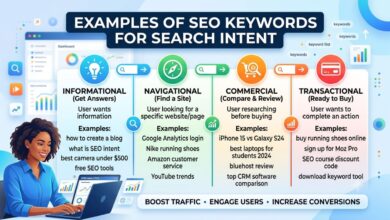
Search Intent: This is also known as audience intent. When a query is searched for by a user on a search engine, it is referred to as search intent.
SEO Audit: This is a type of report for your website that provides a comprehensive analysis of its performance from an SEO perspective. It helps you determine what content is missing from your site and which keywords are needed, as well as identify technical issues that require fixing.
Conclusion
In today’s article, we covered SEO terminology and definitions. You should now have a good understanding of basic SEO terms. It is essential for any SEO expert to be familiar with these concepts; this knowledge will allow you to easily track your progress and execute your work effectively.