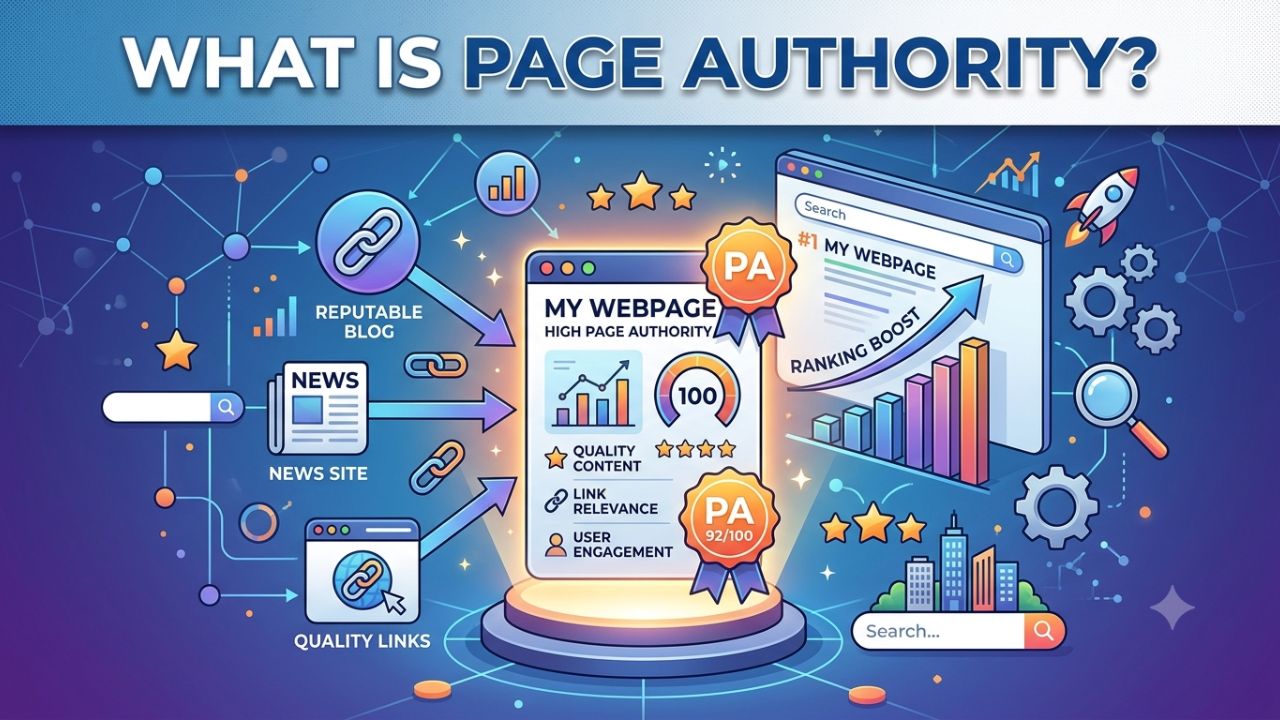
Page Authority (PA) is a value score search engines place on webpages. PA score is calculated based on various factors, such as the quantity and quality of links.
If you think Page Authority and Domain Authority are the same, but they are different from each other. Both play a crucial role in ranking a webpage on search engines. With the right SEO strategy, Page Authority can be easily increased.
It is essential for new bloggers to understand DA and PA. We have already explained what Domain Authority is; in this article, we discuss Page Authority.
Page Authority is a type of SEO score developed by Moz. Like Domain Authority, the PA score ranges from 0 to 100. It fluctuates over time in accordance with Google’s algorithms.
Page Authority indicates the ranking potential of a specific page on your website. A page with a higher score will rank better in search engines, driving more traffic to your site and increasing your earnings. Crucially, a higher PA for your website generally correlates with higher DA.


Increasing your blog’s page authority directly translates to boosting your chances of achieving a high ranking on search engines. The most beneficial factor for increasing page authority is receiving links to your site from other sites that possess a high Domain Authority (DA) rank.
Page Authority can be a useful benchmark. If you also want to increase your website’s Authority, you can do so by following a few simple methods listed below.
1. Earn High-Quality Backlinks
Backlinks are central to Page Authority, relevant link from a credible, authoritative website can be considerably more valuable. Build high-quality, Dofollow backlinks from websites with high Domain Authority (DA). You can build backlinks by guest blogging, submitting your website to directories.
2. Create Content
Backlinks alone are not enough to build authority. Create something useful enough to cite. Your content should be interesting, educational, and engaging.
You might:
- Replace outdated sources.
- Add recent research.
- Expand underdeveloped sections.
- Improve formatting and readability.
- Add missing expert perspectives.
- Strengthen E-E-A-T signals.
3. Update and Improve Existing Pages
Keep your content updated to generate new links. Don’t forget to include fresh statistics or information during updates. Improving existing pages significantly boosts PA more effectively than simply adding new pages.
4. Improve On-Page SEO
Basic on-page SEO still matters to increase website authority. Your website meta details may not directly determine rankings.
Review elements such as:
- Title tags.
- Headings.
- Meta descriptions.
- Image optimization.
- Keyword placement.
- Readability.
- Content freshness.
5. Invest in Technical SEO
If search engines cannot properly crawl or index your website’s content, your authority will not increase. Crawl errors, slow page speeds, broken links, and poor mobile performance—all of these harm the website.
- Crawlability and indexing problems.
- Incorrect robots.txt directives.
- Slow page speed.
- Poor mobile usability.
- Broken links.
- Redirect issues.
- Site architecture problems.
By following all the tips mentioned above, you can easily increase the PA (Page Authority) rating of your website pages. While the authority of individual web pages may vary, the Domain Authority remains the same for all pages.
You will find many online sites where you can easily check your website’s Page Authority, and these services are completely free.
Here, we are sharing a few sites that provide information on both Page Authority and Domain Authority.
- Moz Explorer Tool
- Smallseotool
- Ubersuggest
You need to visit this website and enter your site’s URL; after that, you will be able to see your site’s Page Authority.
Domain Authority and Page Authority share many similarities and were both created by Moz; however, many people often get confused between the two. High scores in both metrics are crucial for ranking a website in search engines, and these scores depend on backlinks. Below, we have outlined the differences between Domain Authority and Page Authority.
| Domain Authority | Page Authority |
| Domain Authority indicates the ability of an entire domain to rank in search engines. | Page Authority indicates the ability of a specific webpage to rank in search engines. |
| Domain Authority is given greater importance. | Page Authority is given less importance compared to Domain Authority. |
| To increase Domain Authority, you have to work on the entire domain. | To increase Page Authority, you need to work on the website’s webpages. |
To rank any site in search engines, having good Domain and Page Authority is essential. This builds the search engine’s trust in your website. Many new bloggers consistently publish content but neglect site authority, resulting in a lack of traffic. Therefore, you must focus on improving the PA of your site’s webpages.
Conclusion
Page authority is an important concept in the world of content and SEO. PA scores typically range from zero to 100. The higher this metric is, the better your site’s pages will rank.
I hope you understood what Page Authority is, how to increase it, and how to use it to rank your keywords on search engines. I have explained all of this to you in detail.
FAQs
What is Page Authority (PA)?
Page Authority is a metric created by Moz that estimates on a scale from 0 to 100.
Why is the Authority Score important?
DA and Page Authority determine how trustworthy your site is.
Does building backlinks increase page authority?
If you use internal links on your site, it will help increase page authority.
Is Page Authority a Google Ranking Factor?
No. Page Authority is not a Google ranking factor.
Does internal linking increase page authority?
Internal linking can help page authority, but not directly.