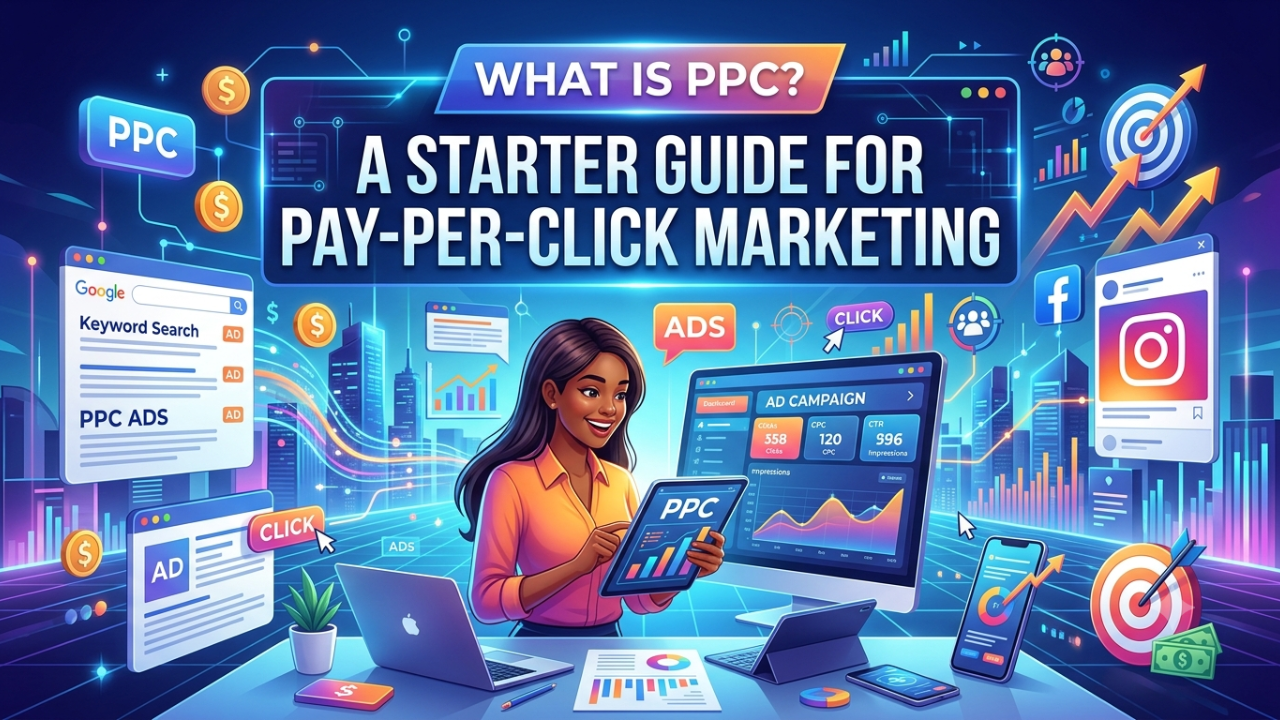
PPC, or pay-per-click Marketing, is a digital advertising technique used to ensure your website appears in the search results. With (PPC) pay-per-click marketing, paid ads can be displayed alongside search results for specific keywords to rank your business.
Nowadays, every mobile user spends the majority of their time online. If you look around, everyone is using digital products and has even started purchasing all their necessities online. You simply need to make a click, and everything you require will be delivered to you.
If you are a businessperson or a blogger and wish to promote your products and services online, this information will prove to be very important for you. It will enable you to easily reach a wider audience with your business—and do so with minimal time and expense.
PPC is a type of marketing strategy that allows anyone to take their business products online and generate significant revenue. Major companies are already utilizing it. So, let’s explore what PPC is, its benefits, and how to use it.
What is PPC?
PPC stands for pay-per-click and is a model of digital advertising where user pay a fee each time someone clicks on your ad. That means PPC allows you to only pay for visits to your website or app, rather than just paying for your ad to be seen.


PPC is a component of digital marketing primarily used for paid advertising, where a company or user pays based on the number of clicks received.
One of the most popular forms of PPC is search engine advertising, which allows advertisers to pay for ad placement in a search engine. Its purpose is to drive customers to a business; this is achieved by paying to display ads to users, which visitors can click on to reach your website.
For instance, if you promote your product or website on Google, it is referred to as paid marketing. The method a company or website uses to boost the visibility of its link—bringing it to the top of search results—is known in the digital marketing world as PPC, or Pay-Per-Click.
How does PPC work?
In PPC (Pay-Per-Click), the advertiser pays based on each click; essentially, you are charged only when a user clicks on your ads.
For instance, if you decide to promote your business using Google AdWords and pay Google ₹1,000, Google will provide you with the number of leads equivalent to that ₹1,000 investment.
If you search for something on Google—such as “Grocery Online”—you will see a list of results. You will notice that the first 3 to 4 results are marked with the label “Ads.” These are paid advertisements displayed via Google AdWords.
PPC Advertising Company
- Google Adword
- Yahoo Search Marketing
- Microsoft Adcenter
If you want to run PPC ads, you should know that Google AdWords, Yahoo Search Marketing, and Microsoft AdCenter are the three main network operators.
Types of PPC Ad Campaigns
PPC marketing involves various types of advertisements, through which users are reached using different techniques.
Search Ad:This includes advertisements displayed at the top of search results on search engines like Google or Bing. Whenever a user searches for specific keywords, they can see ads related to them.
Display Ads: These ads are displayed on various websites and blogs; they appear based on the user’s interests and search results.
Native Ads: Such ads appear as articles on blogs and news websites; you can easily find them on many news agencies and entertainment sites.
Benefits of Pay-Per-Click
If you want to boost your product sales, PPC is the best method. It offers numerous benefits, which we are outlining here.
Instant Result
The biggest advantage of PPC is that it delivers instant results; Google immediately provides you with a top search engine ranking. If you have created a website and want to generate leads right away, you can use Google Ads to bring your site to the number one spot on Google’s first page.
Targeted Audince
PPC allows you to reach a targeted audience with ease, helping you attract the specific clients who are most beneficial to your business. Through PPC ads, you can target the exact individuals searching for your products or services, which significantly increases the likelihood of conversions.
This also allows you to retarget individuals who visited your site but did not take any action. The biggest advantage of retargeting is that you already have information about your audience, enabling you to show them ads for your latest products.
Budget Friendly
You can market your product even without a massive marketing budget; there is no need to set aside hundreds of thousands. PPC marketing can be executed with a very modest budget. A key advantage is that you only incur costs when a user actually clicks on your ad.
Therefore, you can run ad campaigns by preparing a keyword list that balances high search volume with low CPC (Cost Per Click) options, all tailored to your budget.
Measurable and Trackable
With PPC ads, you can measure and track your campaigns, which greatly assists in formulating your advertising strategy. In traditional marketing, campaigns cannot be tracked; this often leads to higher marketing costs without yielding results. In contrast, Google Ads or PPC advertising makes this process very easy.
Conclusion
PPC marketing is a paid marketing stratefy that can significantly boost a brand’s visibility, drive targeted traffic, and increase conversions. In a PPC campaign, advertisers create ads that are displayed to users based on specific keywords or demographic criteria.
Frequently Asked Questions
What is PPC in simple words?
PPC in the digital marketing model is where advertisers pay only when someone clicks their ad.
What is the Pay per click platforms?
Major pay-per-click (PPC) platforms are Google ads, Microsoft advertising, and Amazon advertising.
Does pay-per-click really work?
Yes, pay-per-click works by driving targeted traffic to your website, generating leads or sales quickly.
What is the cost of pay-per-click?
The cost of pay-per-click (PPC) ranges from $0.50 to $3 per click on average.
What is the purpose of PPC?
The purpose of PPC is to drive targeted traffic to a website, generate leads, and boost sales quickly.