

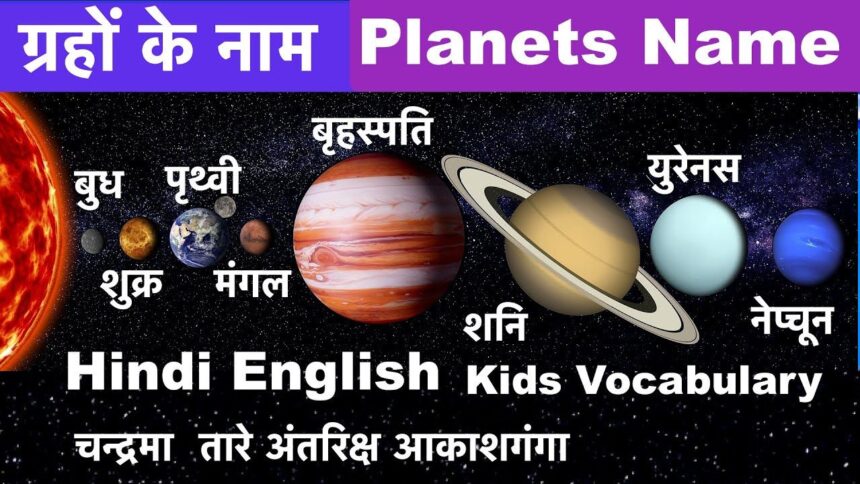
Planets Name in Hindi and English: Young children are taught about planets in school, including how many planets exist in the solar system. Questions about planets are also asked in many competitive exams. By the way, our Earth is also a part of this solar system.
Our Earth and all the other planets revolve around the Sun. Our solar system includes Mercury, Venus, Earth, Mars, Jupiter, Saturn, Uranus, and Neptune. All these planets are very big in size but all these planets can also be seen with the help of a telescope.
Today, in this article, we’re going to give you complete information about the names of all the planets in Hindi and English. You can see the full article in detail below.
Planets Name in Hindi and English
There are a total of eight planets in the solar system, but there used to be nine. Pluto was removed from this category and placed in the dwarf planet category. This means there are now eight planets in the solar system. You can see the names of all the planets below.
| S.NO | Planets Name In Hindi | Planets Name In English |
| 1 | बुध | Mercury |
| 2 | शुक्र | Venus |
| 3 | पृथ्वी | Earth |
| 4 | मंगल | Mars |
| 5 | बृहस्पति | Jupiter |
| 6 | शनि | Saturn |
| 7 | अरुण | Uranus |
| 8 | वरुण | Neptune |
Chief Justices Of India – List of all Chief Justices of India
Mercury planet
Mercury is the closest planet to the Sun. It is smaller than the other planets, located approximately 57.91 million kilometers from the Sun. Human life is impossible on Mercury because it lacks an atmosphere. Just as the seasons change on our Earth, the seasons never change on the planet Mercury; the weather here always remains the same.
Venus planet
Venus is also considered the second closest planet to the Sun. It takes approximately 225 days for Venus to orbit the Sun. Venus is composed of approximately 90-95% carbon dioxide. The temperature on Venus is approximately 462°C. Its surface is composed of metals such as silicon and iron.
Earth
Earth is the third closest to the Sun. It takes approximately 365 days for Earth to orbit the Sun. Human life is possible on Earth. Earth is the densest planet in the solar system. About 71% of the Earth is covered with water and 29% is covered with land.
Mars
Mars is the fourth planet from the Sun, approximately 141.6 million miles from the Sun. Mars is also called the Red Planet because the surface of Mars appears red like rusted iron.
Jupiter
Jupiter is the fifth planet from the Sun, approximately 749.57 million kilometers away. Jupiter has more than one satellite, a total of 79. Jupiter is made of hydrogen and helium.
Saturn
Saturn is the sixth planet from the Sun, located approximately 1.434 billion km away. Saturn has approximately 82 satellites. Saturn is the second largest planet in the Solar System after Jupiter.
Uranus
The planet Uranus is located at a distance of about 2.871 billion KM from the Sun. The planet Uranus was discovered by William Herschel in 1781 AD. Uranus is the coldest planet in the Solar System with a minimum temperature recorded of -224 °C.
Neptune
Neptune is approximately 4.495 billion kilometers from the Sun. Neptune is rich in ammonia and methane. It takes approximately 164.79 years for the planet to orbit the Sun.
Conclusion
Planets are celestial bodies that rotate the sun in a fixed orbit. For Hindus, the planets form an integral part of astrology and religious life. Our solar system consists of eight planets Mercury, Venus, Earth, Mars, Jupiter, Saturn, Uranus and Neptune. Earth has one Moon but Jupiter has the most Moons it has over 50 Moons.