
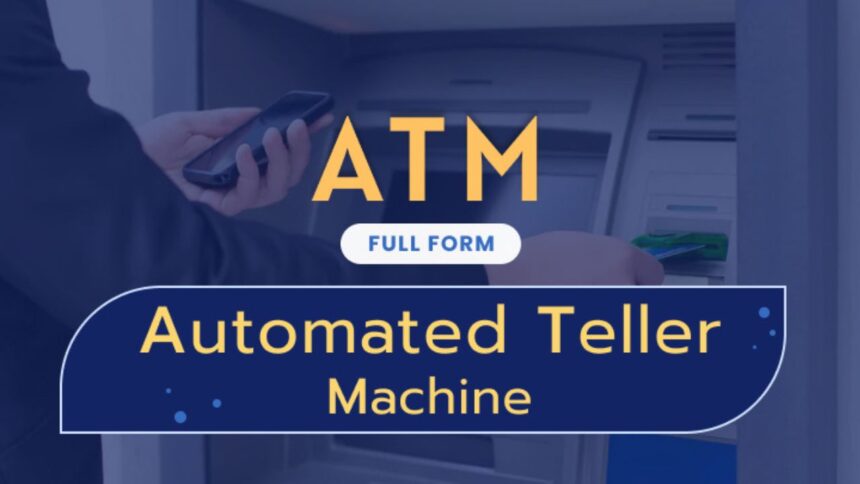
ATM full form in banking stands for Automated Teller Machine. ATMs are something that’s used in everyday life. Whether you need to withdraw money or send money, we use ATMs for all purposes.
But have you ever wondered what the full form of ATM is? We’re going to explain in detail who invented the ATM and what its advantages and disadvantages are. If you want to know more about ATMs besides its full form, read this article.
What is ATM?
In simple words, ATM Card is a type of plastic card which is given by the bank for the convenience of the account holders. With the help of this card you can carry out your financial transactions like cash withdrawal, deposit, fund transfer and other bank related transactions at any time.
You don’t need to visit a bank for this. With an ATM debit card, you can perform many tasks, including online shopping, mobile recharging, and online bill payments.
Whenever you open an account with a bank, after a few days the bank sends you a place card called an ATM card. This card has a magnetic strip on it that contains all the user’s bank details.
When you insert this card into the ATM, the ATM contacts its server to check if your card is wrong and after checking all the details, you can do whatever you want.
You can do tasks like Balance Check, Mini Statement, Fund Transfer and many more. To complete the task, your ATM machine asks for the PIN of your card as per the input. After this, the bank checks these details whether the PIN you have entered is correct or wrong. Finally, if everything is correct, the transaction is completed by the ATM and your money is withdrawn.
Hindi Varnamala – Worksheet, Charts, Vowel and Consonant
ATM full form in Hindi
The full form of ATM is “Automated Teller Machine.” In Hindi, it is called “automatic counting machine.” ATMs are known by different names in different countries. For example, in Canada, ATMs are called ABMs (Automatic Banking Machines), and in other countries, they are called cash points. You might be surprised to know that in some countries, they are also called Hole-in-the-Wall.
Some people also say the full form of ATM is “Any Time Money,” which is incorrect. ATMs were first introduced in India in 1987, and since then, many features have been added to ATMs.
Now let us know about some more full forms of ATM which are given below.
- Air Traffic Management
- Asynchronous Transfer Mode (I.T. Sector) This is a telecommunication concept defined by ANSI and ITU.
- Association of Teachers of Mathematics (This is a non-profit organisation based in the UK.)
- Angkatan Tentera Malaysia (Malaysian Armed Forces)
- Altamira Airport is an airport located in Altamira, Brazil.
What are the parts of an ATM?
An ATM is a type of machine that dispenses money. Anyone with a bank account can withdraw money using an ATM. Now, we’ll explain the parts of an ATM.
Input Device
Card Reader: It thoroughly reads the ATM card’s physical data and sends the information stored on the magnetic stripe to the server for verification. It allows cash withdrawals based on account information and commands from the user service.
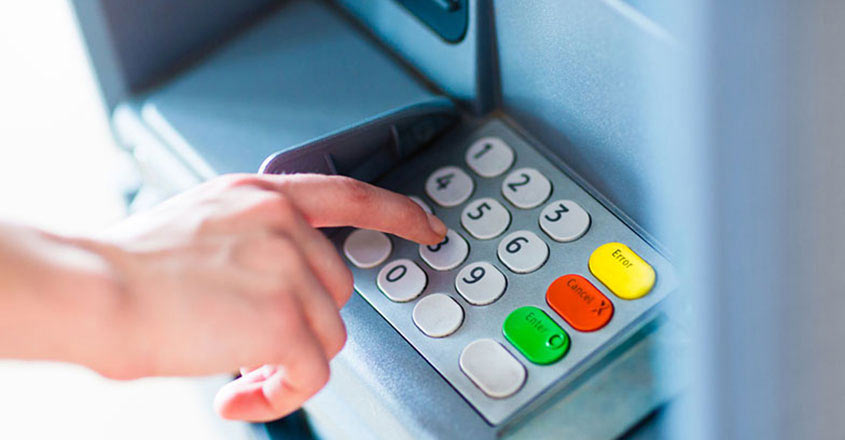
Keypad: The keypad on the ATP allows you to input the amount of money you want to withdraw and other features like cancel, clear, enter, etc.
Output Device
Screen: It is used to display account related information, and the actions you need to take to successfully complete your transaction.
Speaker: Almost all ATMs have speakers. This is to provide audio feedback as you make your transaction.
Cash Dispenser: This is one of the most important output devices of an ATM. It is used to dispense cash.
Receipt Printer: It provides a receipt regarding your transaction, which includes the withdrawal amount, balance, date, time, location, etc.
Advantage of ATM
- The biggest advantage of an ATM is that you don’t need to carry any money with you.
- You can check the balance in your account using an ATM.
- The biggest advantage of an ATM is that you can withdraw money anytime, day or night.
- Wherever you are, city or village, you can easily withdraw money from an ATM.
Disadvantage of ATM
- You cannot withdraw more than Rs 50,000 from an ATM in a day.
- If your ATM card is lost, anyone can misuse it.
- You may incur a charge for withdrawing money more than once.
- You may face financial difficulties if the ATM runs out of cash.
What are the main functions of an ATM?
- ATMs allow us to easily withdraw our deposited funds. We can also find out how much money is left in our bank account.
- When withdrawing money from an ATM, all the information is available on a receipt or slip.
- With the help of an ATM, we can also link our mobile number to our bank account.
- This way we can get our new PIN.
- You can send money to anyone using an ATM.
- We can also transfer money to any other ATM card.
- We can use an ATM to shop and pay fees.
Conclusion
Today, in this post, I explained the full form of ATM, who invented it, and its advantages and disadvantages. I hope you now have complete information about ATMs.
If you have any questions about the ATM full form, please ask in the comments. If you find this information helpful, please share it with others.