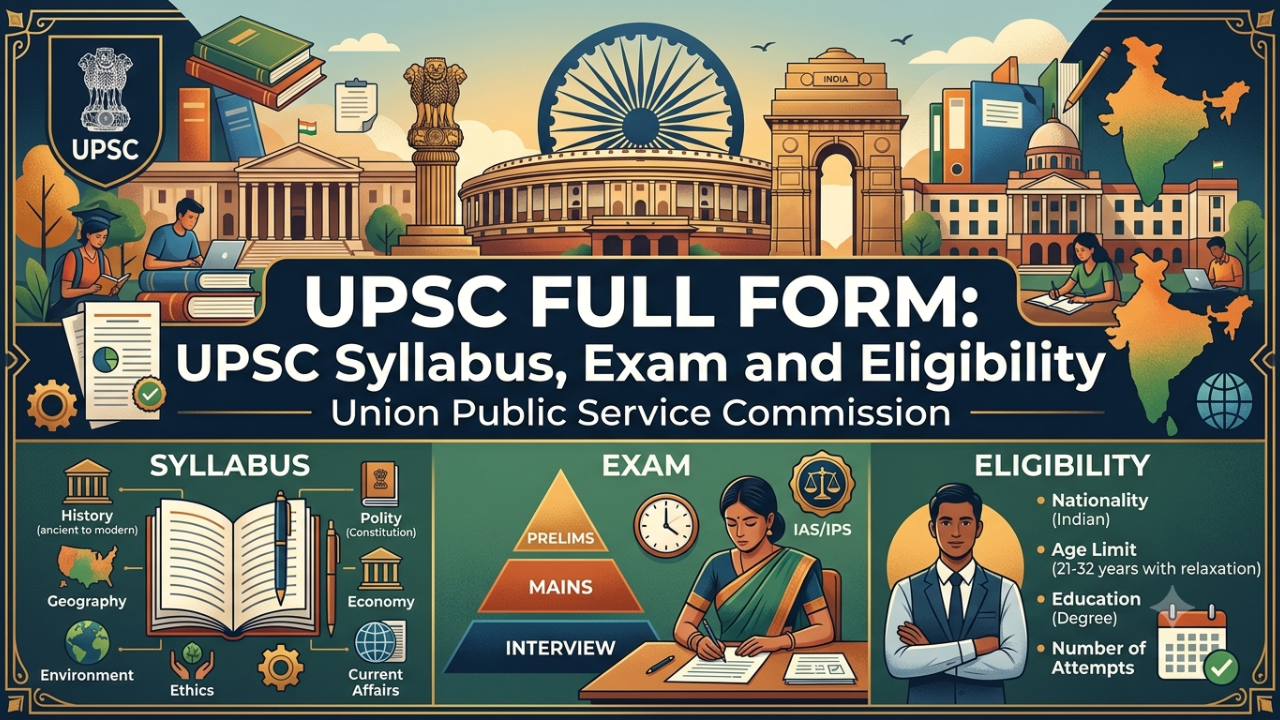
UPSC Full Form is the Union Public Service Commission, a constitutional body established under the Indian Constitution to conduct exams for recruiting civil servants.
It is a central agency of the Government of India that conducts numerous competitive examinations for government jobs every year. Every year, numerous candidates appear for the UPSC exam. For your information, the UPSC is a highly prestigious, popular, and well-known institution in India.
This article will walk you through everything about UPSC, from what it does and how the exam works to eligibility rules, salary details.
So without any delay let us start this post with what is the full form of UPSC? and what is UPSC?, how does it work and how to prepare for it.
What is UPSC?
The UPSC is a department created by the Constitution of India, tasked with recruiting Level A and Level B employees for various offices in India. This organization operates independently, and no body or organization can interfere with its work, even the Prime Minister and President.

The Civil Services Examination is one of the most difficult competitive exams in India. The UPSC was established on January 26, 1950, as the Indian Administrative Service. It was later renamed the Public Service Commission.
Successful success in the UPSC Civil Services Examination is crucial for candidates pursuing higher positions like the IAS and IPS. The Union Public Service Commission conducts this examination in two stages: the Preliminary and Main exams, followed by an interview.
UPSC Full Form
Full form of UPSC is Union Public Service Commission. Its headquarter is in New Delhi and its official website is www.upsc.gov.in.
Services Offered Through UPSC CSE
Being the toughest competitive exam in the country, the positions offered after passing these exams are also highly respected. Let’s take a look at the UPSC exam positions:
| Service | Full Form | Category | Type | Primary Role |
| IAS | Indian Administrative Service | All India Service | Group A | District & state administration, policy implementation |
| IPS | Indian Police Service | All India Service | Group A | Law & order, policing, internal security |
| IFoS* | Indian Forest Service | All India Service | Group A | Forest & environmental management |
| IFS (Foreign) | Indian Foreign Service | Central Service | Group A | Diplomacy, embassies, foreign policy |
| IRS (IT) | Indian Revenue Service – Income Tax | Central Service | Group A | Direct tax administration |
| IRS (C&IT) | Indian Revenue Service – Customs & Indirect Taxes | Central Service | Group A | GST, customs, indirect taxes |
| IAAS | Indian Audit & Accounts Service | Central Service | Group A | Government auditing (CAG) |
| ICAS | Indian Civil Accounts Service | Central Service | Group A | Government financial management |
| IIS | Indian Information Service | Central Service | Group A | Media & communication for government |
| IPoS | Indian Postal Service | Central Service | Group A | Postal system administration |
| IRAS | Indian Railway Accounts Service | Central Service | Group A | Railway finances |
| IRTS | Indian Railway Traffic Service | Central Service | Group A | Railway operations & logistics |
| IRPS | Indian Railway Personnel Service | Central Service | Group A | HR management in Railways |
| IDAS | Indian Defence Accounts Service | Central Service | Group A | Defence financial administration |
| ICLS | Indian Corporate Law Service | Central Service | Group A | Corporate regulation & compliance |
| DANICS | Delhi, Andaman & Nicobar Islands Civil Service | UT Service | Group B* | Administration in Union Territories |
| DANIPS | Delhi, Andaman & Nicobar Islands Police Service | UT Service | Group B* | Policing in Union Territories |
| Pondicherry Civil Service (PCS) | — | UT Service | Group B | Administration in Puducherry |
| Pondicherry Police Service (PPS) | — | UT Service | Group B | Policing in Puducherry |
List Of UPSC Exams
- Civil Service Examination
- Indian Forest Service Examination
- इEngineering Services Examination
- Combined Defence Services Examination
- National Defense Academy Examination
- Naval Academy Examination
- Combined Medical Services Examination
- Special Class Railway Apprentice
- Indian Economic Service/Indian Statistical Service Examination
- Combined Geoscientist and Geologist Examination
- Central Armed Police Forces(Assistant Commandant) Examination
UPSC Exam Pattern
Before preparing for the UPSC, it’s crucial to understand its exam pattern. If you understand it well, you can easily pass this exam. The UPSC exam pattern is as follows.
- Written Exam – 1750 points
- Interview – 275 points
- Total Marks – 2025 points
UPSC IAS (Indian Civil Service)
IAS Full Form: IAS Full Form is Indian Civil Services. It was formerly known as the Imperial Civil Service (ICS). IAS is the Indian Administrative Service (IAS) a civil service.
It is the most prestigious administrative civil service of India and also one of the toughest competitive exams in India.
The IAS exam is conducted by the UPSC (Union Public Service Commission) to recruit officers for the All India Administrative Civil Services.
UPSC IPS (Indian Police Service)
IPS Full Form and Other Details – IPS stands for Indian Police Service. This service is also one of the most prestigious and respected civil services in India.
Becoming an IPS is not easy and for this one has to go through many examinations and rigorous training. An IPS has to be vigilant towards his law and the trust of the people.
(UPSC Full Form) – After knowing the UPSC full form, if you want to prepare for the UPSC exam, then before doing this, the candidates must have knowledge of the following things.
Age : To appear for the UPSC exam, a candidate must be at least 22 years old. The maximum age is 32 years for the general category, 35 years for OBC, and 37 years for SC/ST.
Nationality : Citizens of India, Nepal, Bhutan, Tibetan refugees who settled in India before 1962 can appear for this exam.
Education (UPSC Education Qualification) : Candidate must have a degree from a recognized University, Correspondence Education, Open University or any equivalent University recognized by the Government of India.
UPSC Attempt Limit : If you are from the General category (GEN), you will be allowed to attempt the exam six times. If you are from the OBC category, you will be allowed nine attempts, and SC/ST candidates can attempt it unlimitedly until they reach the age of 37.
Civil Services Examination (CSE)
Under this examination of UPSC, officers are recruited for Indian Civil Services like IAS, IPS, IFS, IRS, IDES, IIS, etc.
CSE Education Qualification: For CSE, the candidate must have at least a Bachelor’s degree to appear for the exam.
Engineering Services Examination (ESE)
इस परीक्षा के तहत अधिकारियों को Indian Engineering Services (IES) में भर्ती किया जाता है। एक IES अधिकारी सड़कों, रेलवे, निर्माण, बिजली आदि के तकनीकी पहलुओं में काम करता है।
ESE Education Qualification: To appear in this exam also, the candidate must be an engineering graduate.
National Defence Academy Examination (NDA)
This exam is conducted by UPSC twice a year for the candidates who want to take admission in National Defence Academy.
Qualification (NDA Education Qualification): For this also, it is very important for the candidate to have passed the Intermediate examination and be unmarried.
Conclusion
We hope that you have read this article completely and through this you must have got complete information about UPSC Full Form in Hindi and UPSC, along with this you must have also become aware of what is UPSC Full Form.
Frequently asked question
What is the Full form of UPSC?
The full form of UPSC is the Union Public Service Commission.
Which exam is conducted by UPSC?
The UPSC conducts competitive exams for services like IAS, IPS, IFS and other civil services.
Is UPSC only for IAS?
No, the Union Public Commission service holds examinations for 20+ top level government services.